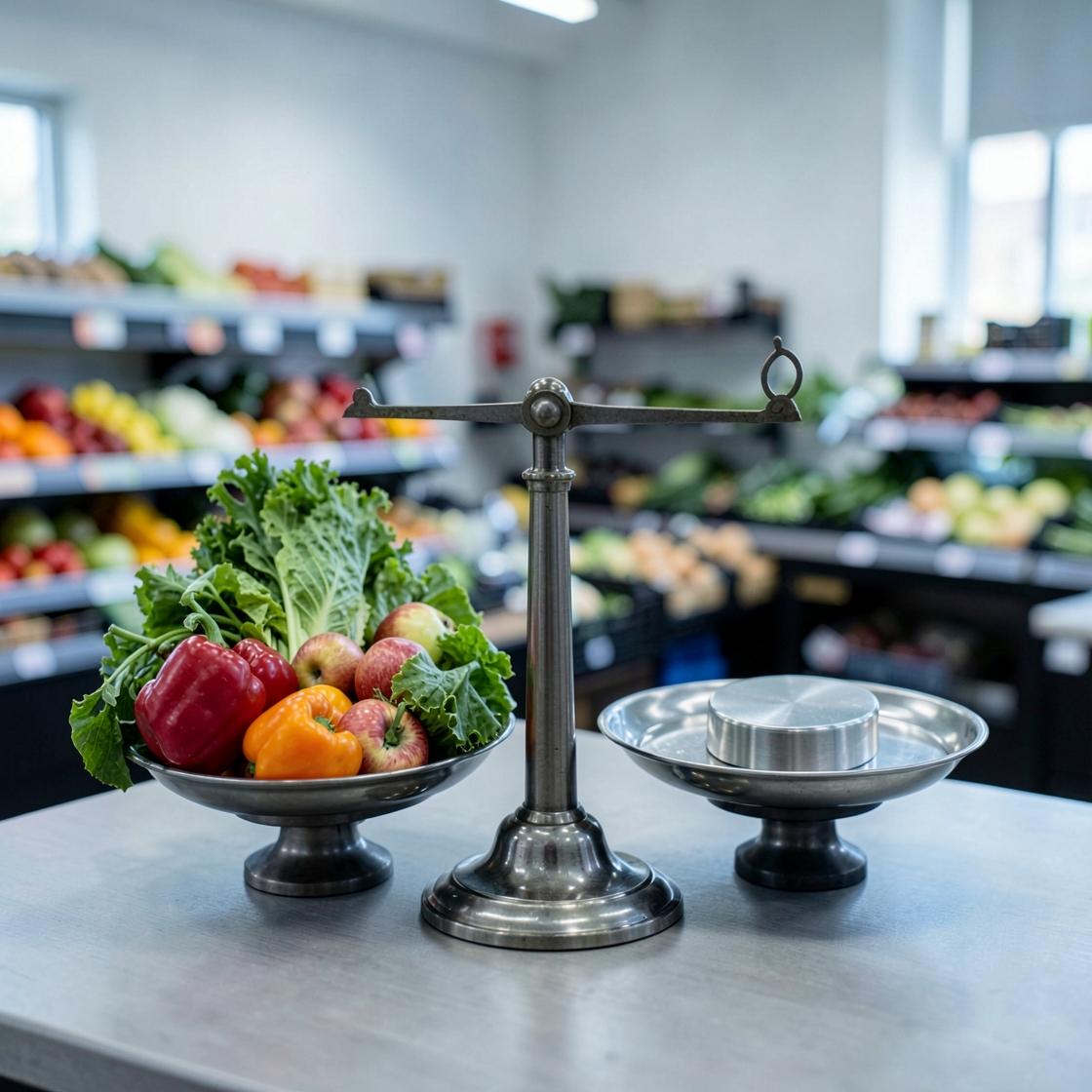
British shop-price inflation slowed to 0.9% in July, its lowest rate since December 2025. The British Retail Consortium figures reported by Reuters also showed a 0.1% monthly fall, while food-price inflation eased to 2.2% from 2.4%. Discounts around the men's football World Cup helped restrain prices for selected supermarket goods.
For households buying those products, the relief is real. For investors and monetary policymakers, the mechanism matters as much as the direction. A lower shelf price can reflect cheaper inputs, stronger productivity or tougher competition. It can also mean that a retailer has temporarily absorbed costs in its gross margin. The July signal is encouraging, but it cannot identify which channel dominates by itself.
The 0.9% print captures tills, not the whole basket
The BRC-NielsenIQ shop-price monitor tracks prices at retailers. It is timely and relevant to groceries and merchandise, but it does not cover the full consumption basket. Rent-related costs, many services, transport and other categories that shape household inflation sit outside its retail focus.
That boundary explains why the shop rate can be far below official inflation without either measure being wrong. The Office for National Statistics reported that June CPI rose 2.6% year on year and CPIH, which includes owner-occupier housing costs, rose 2.8%. Goods inflation eased to 1.7%, while services inflation remained 3.6%. Food and non-alcoholic beverages in the official basket rose 1.7%.
The common direction is important: retail goods, official goods and official food measures were all easing. The different levels show why the July BRC number should be treated as an early signal for part of the basket, not a substitute for the next ONS release.
Discounts can lower measured prices before costs disappear
The BRC's June shop-price release recorded 1.2% headline inflation and 2.4% food inflation. It attributed restraint to competition, promotions and favorable conditions for some fresh foods, while warning that employment, packaging, energy and other input costs were still pressing on retailers.
Promotions transmit relief immediately. A lower price paid is a lower measured price, even if the offer is temporary. Repeated promotions can also become a durable competitive response when consumers remain price-sensitive and retailers protect volume.
The unresolved question is who funds the discount. If supplier costs are falling, retailers can cut prices while preserving margins. If costs remain high, a promotion trades unit margin for traffic or inventory clearance. The second route can help consumers now but leaves less room for further price cuts unless volume, productivity or supplier terms improve.
This is where a single inflation print and an earnings result can point in different directions. Lower shop-price inflation is positive for household purchasing power. It is not automatically positive for supermarket or general-merchandise profit when the retailer finances the gap.
Food relief meets an energy-services offset
Food carries high visibility because households buy it frequently. The decline from 2.4% to 2.2% in the BRC measure extends the immediate relief, and the ONS data show a similar downward direction in the official basket. If sustained, slower food inflation can support real disposable income even when nominal wage growth moderates.
Broader inflation still has offsetting forces. At its June meeting, the Bank of England maintained Bank Rate at 3.75%. Based on the energy-price assumptions available then, it expected CPI to be a little under 3% in the third quarter and a little over 3.25% in the fourth. The Bank explicitly described that path as conditional and noted that monetary policy cannot determine global energy prices.
That forecast is not a fact about future inflation. It identifies the transmission risk. Energy can raise household bills and business costs, while services inflation reflects wages, rents and domestic pricing behavior that shop discounts do not directly measure. Goods disinflation can therefore coexist with a broader index that stops improving or temporarily rises.
Margin data will show who funded the relief
Retail company reporting can resolve part of the ambiguity. Gross margin, inventory levels, supplier income, promotional intensity and volume growth will show whether lower prices came with healthy operating leverage or with greater absorption by merchants. Comparable sales without volume detail are less useful because inflation can lift revenue even when units fall.
Macro confirmation requires more than one month. The next ONS releases can test whether goods and food disinflation persists, while services and energy determine whether the improvement broadens. A continued decline in shop prices alongside stable retailer margins and lower supplier costs would support a durable disinflation thesis. A rebound after promotions end, or falling retail margins with unchanged input costs, would support the temporary-absorption interpretation.
The counterargument deserves weight: July is not isolated from all other evidence. Official goods and food inflation were already easing, and competition may be passing genuine cost relief to consumers. The point is not to dismiss the 0.9% rate, but to locate it correctly.
Britain's retail channel is delivering lower price growth now. Whether that becomes a lasting household and policy benefit depends on what happens after the discount signs come down. The strongest confirmation will be a combination that rarely fits into one headline: slower prices, stable retailer economics, softer services and no renewed energy pass-through.