
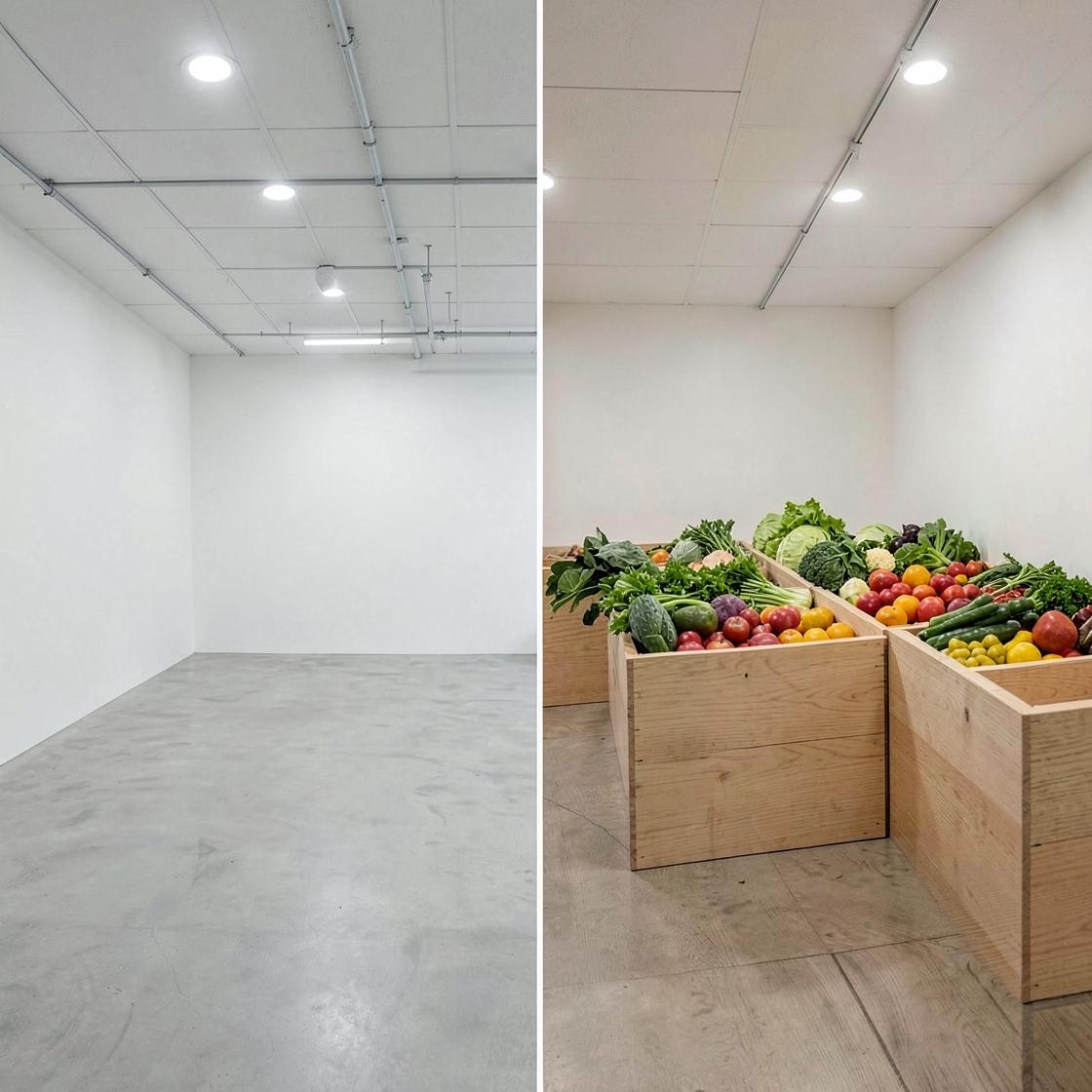
New York City's municipal grocery plan is usually described as a choice between public and private retail. Its own documents show a more interesting hybrid. The city intends to own or prepare five sites, remove major occupancy costs and set affordability rules, while one or more private grocers handle sourcing, staffing, merchandising and daily operations.
The headline promise is an average 30% discount on a core basket of fresh and essential foods. Business Insider's discovery report places the plan beside earlier municipal-store experiments. New York's financial test, however, is specific: can public support be converted into a durable shelf-price advantage without merely moving an unmeasured bill into the city budget?
The shelf price starts with rent removed
The NYCEDC program description assigns the city several costs that a conventional grocer must recover from sales. It will deliver grocery-ready sites, cover rent and property taxes, fund initial buildout and create a common brand. The city has committed $70 million of capital for construction and fit-out across five locations; $30 million is allocated to the ground-up La Marqueta store.
That capital ledger matters, but it is not the same as the operating ledger. Construction spending can create an asset and eliminate a financing burden before the first customer enters. Rent and property-tax support continue to affect annual economics. The city's affordability plan also anticipates targeted investment for lower-cost food, while operators still have to cover staff, inventory, logistics, utilities, shrink and other daily expenses.
A 30% price gap cannot come from gross grocery margins alone across every product. New York avoids making that claim: the discount applies on average to a defined core basket, not to the whole store. The public contribution therefore works through several channels at once — cheaper premises, paid buildout and potentially direct operating support. Treating all of them as one subsidy would obscure whether the model becomes more efficient over time or simply requires a continuing transfer.
Thirty percent needs a benchmark
The core basket is broad. The plan includes all fresh produce, meat and seafood, plus selected dairy, frozen and shelf-stable goods. Prices are supposed to average 30% below market, remain stable for budgeting purposes and change periodically as market conditions move. Non-discounted products must still be fairly priced.
The unresolved variable is the comparison price. A credible benchmark needs matched products or clear quality specifications, a geographic comparison set, a measurement date and rules for promotions. Without those definitions, changing the mix of premium and value items could alter the measured discount even when a household's actual bill does not improve. This is an inference about measurement risk, not evidence that the city intends to manipulate the result.
The distinction between a basket discount and a household saving is also important. City Hall projects that a 30% reduction on core items could lower an average grocery bill by about 15%. That estimate depends on how much shoppers buy inside the discounted basket, whether products are in stock and how the rest of the cart is priced. Transaction-level reporting can test those assumptions after opening; a ceremonial price comparison cannot.
The operator bid will price the hidden subsidy
The live operator request for proposals allows NYCEDC to choose one operator for multiple stores or as many as five separate operators. Respondents must demonstrate sourcing relationships and full-service grocery experience. Evaluation factors include operating experience, proposal quality and requests for subsidy. Proposals are due October 16, 2026.
That last criterion will expose part of the economics. An operator asking for more support may offer a deeper or more reliable discount, better wages, a wider assortment or stronger opening capacity. A lower request may reflect efficiency, but it could also rely on optimistic volume, thinner staffing or profits from products outside the core basket. The award cannot be judged on subsidy alone; the relevant output is the total contract package and its enforceable performance standards.
Labor requirements make the trade-off explicit. The city wants family-sustaining wages, benefits, safe conditions and labor-peace commitments while also demanding low prices. Those goals can coexist if the city-funded occupancy advantage and supply-chain execution are large enough. If they are not, the gap will appear in recurring subsidy, assortment, service quality or operator returns. Publishing bid assumptions and subsequent store-level results would make that trade-off visible.
The strongest case for the hybrid is operational. Municipal ownership can preserve a public affordability mission, while experienced grocers retain control of perishable inventory, vendor terms and store routines that government would be costly to learn. Contracting also gives the city a way to tie support to price, availability and service results. The risk is that accountability becomes divided: an operator can blame the site or subsidy, while the city can blame execution.
Five stores can test a model, not reset a market
The initiative plans one store in each borough, with the first expected at the Peninsula in the Bronx in late 2027. The same city plan counts more than 1,100 grocery stores and over 10,000 bodegas across New York. Five locations cannot directly reset prices across that network, and the city's document says the program is not intended to replace private grocery investment or solve every access gap.
That limited scale is not necessarily a weakness. It makes the first stores a controlled test of whether public real estate and private operations can produce verifiable savings. The most informative evidence will be the operator awards, subsidy per store, matched-basket prices, in-stock rates, customer traffic, shrink, labor retention and the share of purchases made inside the discounted basket. Effects on nearby independent retailers also deserve measurement rather than assumption.
The conclusion would improve if those data show persistent discounts with falling support per transaction and reliable service. It would weaken if the benchmark changes frequently, non-core prices offset core savings, operators need growing subsidies or nearby access deteriorates. New York has already funded the physical ledger. The operating contracts will show whether the second ledger converts public cost into household value.