
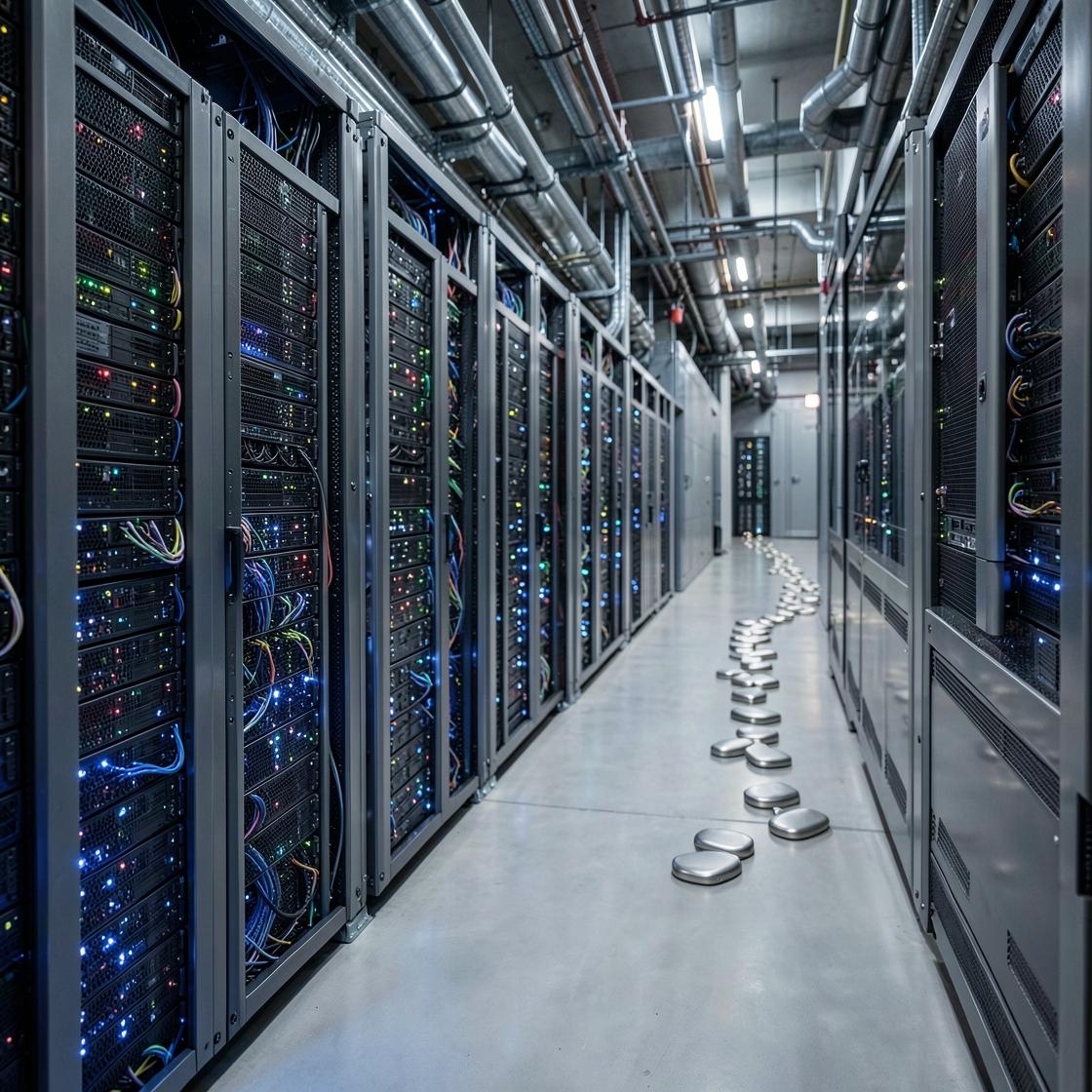
Meta's second-quarter numbers tell two stories that are both true. Its advertising machine is expanding rapidly: revenue rose 28% year over year to $60.8 billion, helped by a 14% increase in ad impressions and a 12% increase in average price per ad. At the same time, the company generated only $784 million of free cash flow. That is not evidence that the core business has stopped working. It is evidence that the cash produced by that business is being redirected into an infrastructure program of a different scale.
The relevant investor question is therefore no longer whether Meta can afford artificial-intelligence infrastructure this quarter. With $90.3 billion of cash and marketable securities, it can. The harder question is whether capacity built for internal models, recommendation systems and future enterprise products will produce returns commensurate with a business that is becoming far more capital intensive.
The cash conversion broke before the ad engine did
The company's earnings release shows the divergence clearly. Operating cash flow reached $31.86 billion, but capital expenditures including finance-lease principal were $31.08 billion. On Meta's non-GAAP definition, which subtracts both property-and-equipment purchases and those lease payments, only $784 million remained as free cash flow. A year earlier the comparable figure was $8.55 billion, so the decline was about 91%.
Profitability weakened for reasons beyond servers. Costs and expenses rose 55% to $42.03 billion, including $2.40 billion of legal charges and $1.18 billion of severance expense. Operating margin fell to 31% from 43%, although Meta said operating income would have increased 9% excluding those two items. This distinction matters: legal and severance charges complicate the quarterly comparison, but they do not explain why capital spending consumed nearly all operating cash.
That also makes the market reaction more informative than a simple revenue miss narrative. Associated Press reported that the shares fell after the release even though revenue grew strongly. The result exposed a different uncertainty: how much of current cash generation remains available to shareholders after the infrastructure bill.
Thirty-one billion dollars of quarterly capex changes the business profile
Meta now expects 2026 capital expenditures of $130 billion to $145 billion, narrowing the prior $125 billion to $145 billion range by lifting its lower bound. Management also expects full-year operating income to exceed 2025, so the company is not guiding to a collapse in the earnings engine. But income and cash flow answer different questions when investment is this large.
A larger physical base brings depreciation, power, networking and data-center operating costs after the initial purchase. Meta also reported $83.66 billion of long-term debt, close to its cash and securities balance. That does not imply immediate financial stress; it shows that financing choices now matter alongside product choices. Management said it is considering long-duration capital and infrastructure partnerships to supplement operating cash, a rational match for long-lived assets but another departure from the old, lightly capitalized platform model.
There is a credible bull case. Recommendation improvements helped drive double-digit growth in Instagram time spent and higher Facebook video engagement, according to the earnings-call transcript. If better models continue raising engagement and ad efficiency, part of the return arrives inside the existing business rather than in a new segment. Quarterly capex can also be lumpy, so $784 million should not be extrapolated mechanically. The burden of proof nevertheless rises when management commits to capacity years before all monetization routes are visible.
Selling spare compute is an option, not a cloud business
Management offered several possible returns on that capacity: improvements to advertising and consumer products, APIs, business agents, developer tools and direct compute sales. Zuckerberg said Meta had received multiple offers for compute at a meaningful premium to its cost, while also arguing that selling intelligence should earn a higher margin than selling raw compute.
Those statements establish optionality, not a functioning cloud segment. Meta did not disclose revenue, contracted backlog, utilization, customer concentration or margins for the proposed enterprise offerings in the materials reviewed. It also acknowledged that serving enterprise customers requires a different organizational capability from selling ads. The commercial question is not simply whether demand for compute exists. It is whether Meta can allocate scarce capacity between internal research, consumer inference and external customers while earning more than its cost of capital.
Raw compute resale could reduce the cost of idle or surplus capacity, but it may also carry lower margins and fewer durable advantages than APIs, agents or productivity software. Conversely, holding all capacity for internal use could maximize strategic control while delaying externally visible revenue. These are different economic models, and grouping them under a broad cloud opportunity would hide the trade-off.
The next proof must connect capacity to cash
The thesis strengthens if Meta restores free-cash-flow conversion while keeping ad growth healthy, or if it begins disclosing enterprise revenue, contracted demand, utilization and margins. Evidence that recommendation gains are translating into sustained pricing or volume improvements would also show an internal return on the build. The current balance sheet gives management time to produce that evidence.
The thesis weakens if capital spending keeps rising faster than operating cash, new financing expands without corresponding cash returns, or enterprise products remain a list of possibilities rather than reported business. A single quarter cannot resolve a multi-year investment cycle, and legal charges make this quarter unusually noisy. But the figure that matters is no longer just revenue growth. Meta has reached the point where investors need a bridge from installed capacity to durable free cash flow.