
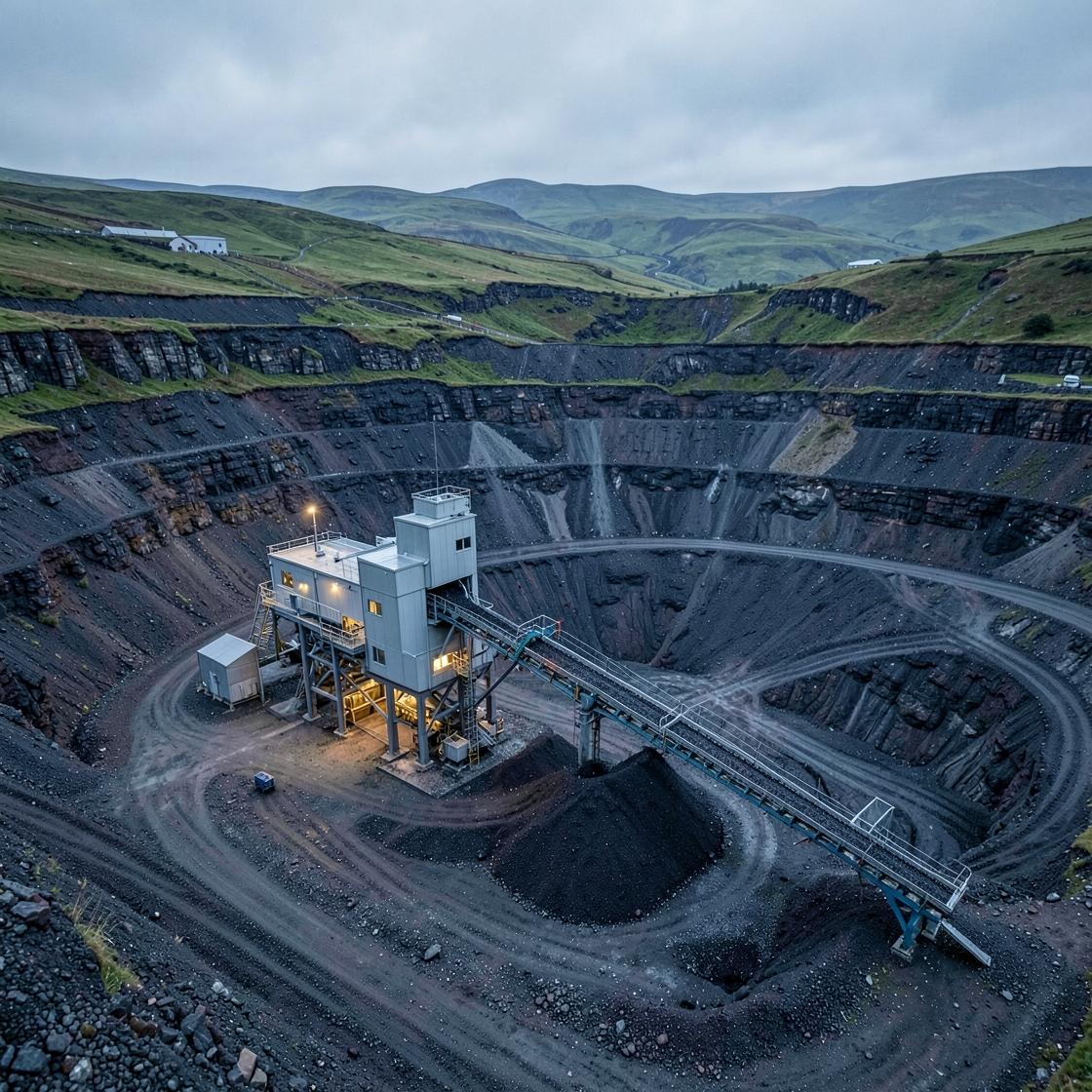
The UK government has offered Hemerdon something a stalled mine cannot operate without: a credible route to capital. It has not yet delivered the other half of the investment case — a plant that repeatedly turns ore into saleable tungsten and tin concentrate.
The National Wealth Fund announced an investment of up to £71 million in Tungsten West, the company restarting the Devon mine. That intervention matters in a market where the US Geological Survey estimates China produced 67,000 of the 85,000 tonnes of tungsten mined worldwide in 2025, or 79%. Yet strategic need does not remove project risk. It changes who bears it and which milestones deserve attention.
The £71 million headline contains three commitments
The company's transaction announcement divides the headline into £36 million of equity, a debt facility of up to £25 million and a further £10 million accordion. That final tranche is expressly non-committed. The Fund's summary groups the last two components as up to £35 million of lending, but the company disclosure shows why £71 million should not be treated as cash already available or disbursed.
The distinction is practical. Equity does not need repayment on a mine's commissioning schedule. Debt does, and drawdowns commonly depend on conditions and permitted uses. An accordion is capacity to expand a facility if a lender later agrees; it is not equivalent to committed funding. The package therefore closes much of the visible financing gap while leaving execution and potentially working-capital needs exposed.
For investors, the next useful disclosure is not another maximum package value. It is the sequence of equity completion, debt availability, drawdowns, spending against budget and any condition attached to the extra £10 million. Those details determine how much cushion exists if commissioning takes longer or costs more than planned.
Equity absorbs the first restart risk
The Fund is subscribing for 100 million shares at 36 pence and would hold about 7.42% of voting rights after admission, according to Tungsten West. That makes the government an owner before full-scale operation, not merely a lender protected by repayment priority. Existing shareholders accept dilution, but the company gains permanent capital able to absorb the early restart risk.
Hemerdon is not a bare greenfield site. Tungsten West says more than $300 million was previously invested and describes a route of less than 12 months from construction start because mining and processing infrastructure already exists. Reusing physical assets can reduce schedule and construction risk. It does not prove that modified equipment will achieve forecast throughput, recovery, product quality or cost. A brownfield restart trades some construction uncertainty for integration and commissioning uncertainty.
The counterargument is strong: existing infrastructure, public sponsorship and high current tungsten prices may create more resilience than the company had during earlier restart efforts. That combination can make the Fund's risk timely rather than reckless. But it strengthens the opportunity only if the capital reaches the bottleneck and the plant clears it.
An offtake window is not a sales contract
The package also gives the UK government an exclusive period to negotiate a right to procure up to 50% of annual production. The Fund says the offtake would be negotiated separately. That is strategically useful optionality, not yet contracted demand.
A signed agreement could improve revenue visibility or support debt confidence, depending on its duration, volume, quality specifications, pricing formula and take-or-pay provisions. None of those economics follows from the maximum 50% figure alone. The denominator also matters: the company ties the right to production contemplated by its 2025 feasibility study, while actual output will depend on the ramp.
The distinction protects both sides of the analysis. The government has created a route to domestic supply without claiming that Britain will become self-sufficient. Its Critical Minerals Strategy combines domestic production, recycling and diversified imports and targets at least 10% of aggregate annual UK critical-mineral demand from domestic production by 2035. Hemerdon can improve resilience without eliminating import dependence.
The feasibility case is sensitive to metal prices
Tungsten West's 2025 feasibility study reported a 29% internal rate of return and a $190 million net present value at a 7.5% discount rate. Those are company-modelled outputs, not realised returns. The model used an ammonium paratungstate, or APT, tungsten price of $400 per metric tonne unit and a tin price of $32,500 per tonne.
In its March 2026 project update, the company reported spot indications far above the tungsten assumption and above the tin assumption. That can widen the theoretical margin and financing cushion. It can also tempt analysts to capitalise a cyclical price immediately while discounting operational uncertainty.
The test is not whether spot prices exceed a feasibility assumption on one date. It is whether realised prices, payable terms and recoveries exceed cash costs through a ramp that may produce less than nameplate capacity. Concentrate specifications, penalties, hedging and working capital can all separate a quoted commodity price from mine cash flow.
Commissioning converts strategic value into supply
The Fund and company target full-scale production in the first quarter of 2027. A target is evidence of schedule, not evidence of completion. The relevant bridge runs from construction and equipment installation to cold and hot commissioning, stable throughput, consistent recovery, saleable concentrate, customer acceptance and cash collection.
Several disclosures could materially strengthen the thesis: completion of the equity and debt conditions; a fully committed funding runway; a signed offtake with commercial terms; monthly throughput and recovery during ramp-up; product quality against buyer specifications; and cost or working-capital performance against the feasibility plan. Delays, repeated plant modifications, weaker recovery or reliance on the uncommitted accordion would weaken it.
The public investment is consequential because it can move a strategically relevant existing asset across its financing barrier. It is not proof that the barrier was the last one. Hemerdon's value to the UK will be measured not by the maximum size of the package or the tonnes underground, but by reliable concentrate leaving the plant under durable economics.