
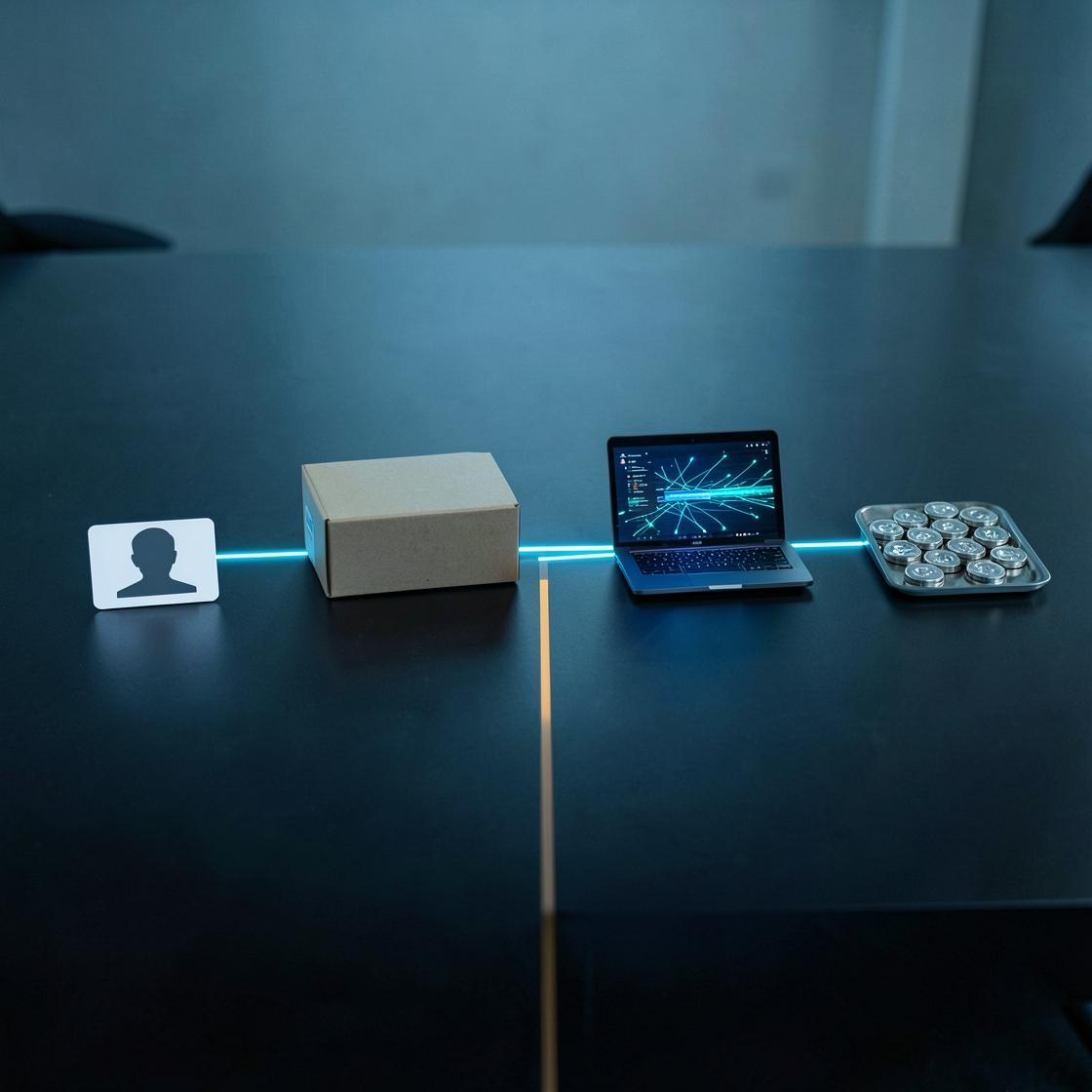
A candidate can pass a video interview, receive a laptop at a U.S. address and enter payroll through an account bearing the expected name. Every event may look valid inside its own system while the person interviewed, the identity on file, the laptop operator and the ultimate recipient of the salary are not the same person.
That separation is the mechanism behind North Korean remote IT-worker fraud. A July 31 alert hosted by the FBI's Internet Crime Complaint Center describes false identities, third-party interview proxies, AI-assisted impersonation, remote-desktop tools, laptop farms and third-party payment accounts. The scheme is therefore not only a cybersecurity problem or an HR failure. It is a control-design problem across HR, IT, security and finance.
A valid payroll record can still describe the wrong person
Stolen identity data can be authentic enough to pass a document or background check. The current alert says a third party may supply identification, create an account, join an interview or even appear in person, while a North Korean worker performs the contracted work. Teams may also operate one persona at different times. A company can verify a real name without proving continuity between applicant, employee and operator.
The payment leg creates another separation. The alert lists mismatches between the account holder and the registered payment account, frequent changes to bank information and requests for money-transfer services or cryptocurrency. Those are not proof individually. Together with reused contact details, changing shipping addresses or inconsistent access patterns, they can show that one employment record is serving several actors.
This is not a hypothetical control weakness. In April, the U.S. Justice Department announced sentences in a scheme that used at least 80 stolen identities to obtain jobs at more than 100 U.S. companies. The department said it generated more than $5 million for North Korea and caused companies at least $3 million in legal, remediation and other costs. Those figures describe one adjudicated network, not the entire market.
Laptop farms break the location signal
Employers often treat a corporate device at a domestic address as evidence that the worker is where the records say. A laptop farm defeats that inference. A facilitator receives and hosts company computers, then gives overseas operators remote access. The Justice Department said facilitators in the sentenced scheme hosted hundreds of victim-company computers at U.S. residences.
From inside a company, the device may look familiar: approved hardware, a domestic internet connection and valid employee credentials. The mismatch sits one layer behind the endpoint. Useful evidence therefore spans the declared residence, delivery address, device custody, remote-management software and patterns such as one account appearing from several countries in a short period.
Avoiding shipped laptops is not a complete answer. Google Threat Intelligence Group reported expansion into Europe and activity in bring-your-own-device and virtualized environments, where shipping and endpoint inventory produce less evidence. The control has to follow the work session, not one hardware policy.
The loss can begin after the salary stops
The first transfer is the salary. In March, the U.S. Treasury said DPRK IT-worker schemes generated nearly $800 million in 2024 and that the government appropriates most overseas-worker wages. Treasury linked the revenue to weapons programs and sanctioned six people and two entities. For an employer, that adds sanctions and reputational exposure to the direct cost of a false hire.
The access risk is less uniform. Mandiant's incident-response observations found that workers it investigated had primarily operated within their job responsibilities, even though developer and administrator roles gave them elevated access. Competent work can make a fraudulent relationship last longer; it does not remove the insider risk.
An FBI warning says some workers copied code to personal repositories, harvested credentials or session cookies, and extorted former employers with proprietary data after discovery. That does not mean every false hire becomes an intrusion. It means termination cannot be treated as the end of the incident: credentials, repositories, cloud sessions and data movement need review.
Defensible hiring needs one evidence chain
Adding another isolated identity check leaves the architecture unchanged. A stronger process links evidence at four moments. During interviews, teams can compare the live applicant with identity records, prior contact details and repeated résumé content, while asking job-specific questions that reveal who actually did the work. At onboarding, declared residence, equipment delivery and payroll ownership can be reconciled before exceptions are approved.
After access begins, device attestation, prohibited remote-control tools, unusual concurrent sessions and abrupt geographic changes can be monitored together. High-risk engineering roles should start with least privilege and expand only when the work requires it. A bank-account change, new address or access anomaly should not sit in a separate queue if another function has already recorded a mismatch.
There is a real counterargument: intensive verification can slow remote hiring, collect too much personal data and unfairly burden legitimate international candidates. Nationality, accent or remote status is not evidence of fraud. The defensible approach is risk-based and transparent, using inconsistencies across systems and stronger controls for access to source code, production infrastructure or financial assets. It also needs an appeal path for innocent discrepancies.
The public evidence still has limits. Prosecutions and incident-response reports reveal successful schemes, not the share of remote applicants involved or the false-positive rate of each control. Data on detection outcomes, repeated identifiers and which interventions stop payment or access would change the assessment. Until then, the clearest lesson is operational: identity, device, access and payroll cannot be trusted as four independent green lights. They need to describe the same person continuously.