
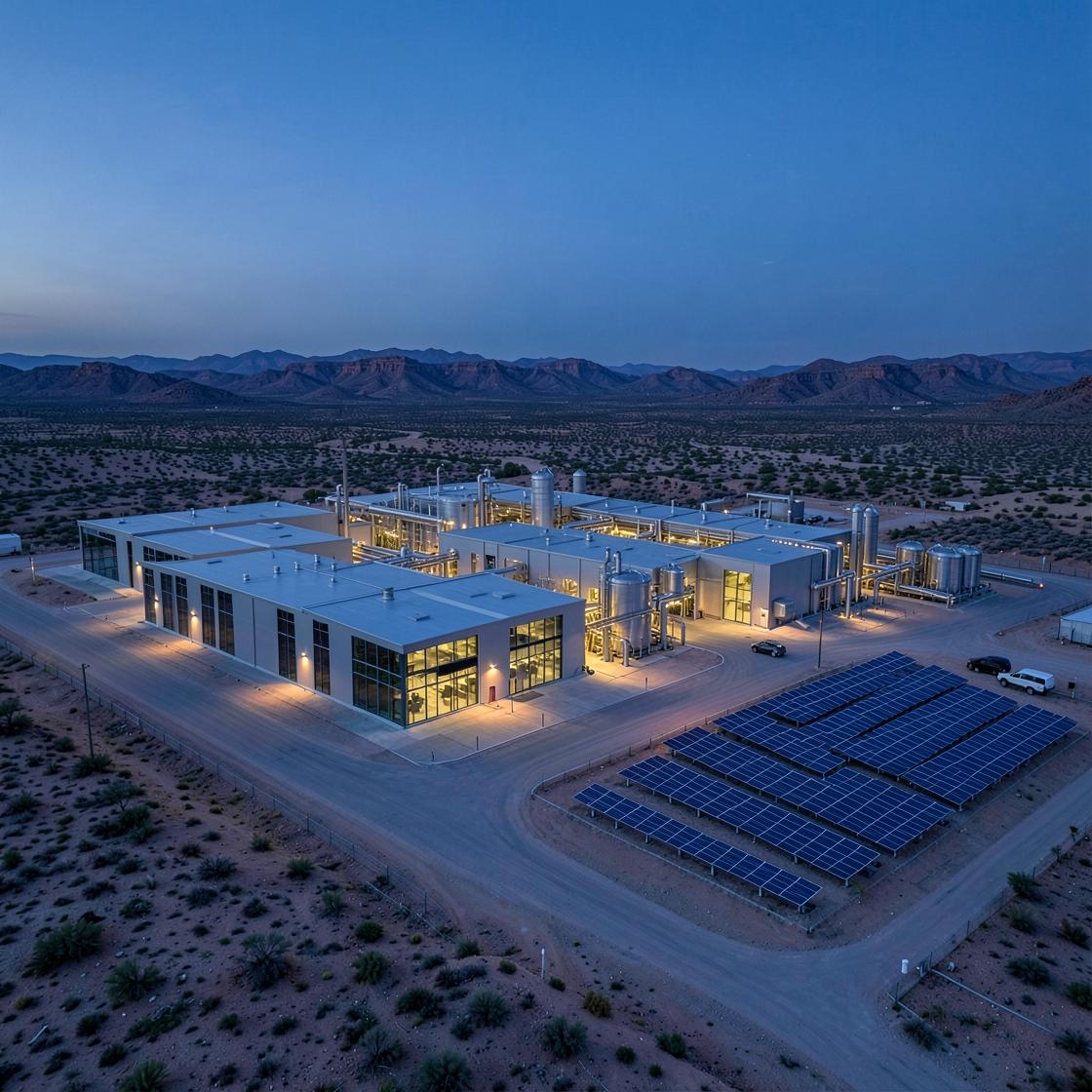
Recent reporting has connected Amazon to GW Ranch, a proposed data-center and power campus in Pecos County, Texas. The important financial fact is not simply that the site could host an unusually large gas plant. It is that the project is designed to make electricity a private input to computing rather than a service delivered through the public grid. The Verge reports that Amazon acquired the site, while the air-permit documents name Pacifico GW LLC as the applicant. That distinction matters: the reported customer relationship and the permitted power project are related claims, not the same legal fact.
The design could shorten one of AI infrastructure's hardest timelines. It also creates a different concentration of risk. A hyperscaler that avoids an interconnection queue must still rely on turbines, pipelines, storage, construction finance, emissions controls and enough computing demand to use the power. GW Ranch is therefore less a story about electricity being solved than about the bottleneck moving from a regulated network to a dedicated industrial system.
The interconnection queue disappears, but the project queue does not
The Texas Commission on Environmental Quality's plain-language permit summary says the natural-gas plant would supply an on-site data-center campus and would neither connect to nor sell electricity into the local utility grid. For the customer, that removes dependence on transmission upgrades and grid allocation. It can also align power capacity with server delivery rather than with a utility's broader investment schedule.
Pacifico presents the project as a phased system, not one monolithic plant switched on at once. Its GW Ranch project page describes up to 7.65 gigawatts of permitted dispatchable generation, 1.8 gigawatts of battery storage and as much as 750 megawatts of solar. The developer says first power is planned for the first quarter of 2027, one gigawatt for 2028 and more than five gigawatts by 2031. Those are company targets, not completed assets.
The economic trade is clear. Private generation may buy speed and control, but the project assumes the execution functions that a grid normally pools across many users. Turbine procurement, gas delivery, maintenance reserves and redundant capacity all become part of the data-center cost stack. Batteries can support reliability and smooth operations, but they do not remove the need to secure fuel for sustained output. If server demand arrives more slowly than generation, fixed capital is underused; if generation arrives late, expensive computing equipment can sit without its critical input.
A 33.2 million-ton ceiling is not an operating forecast
The number attracting attention is 33,212,284.72 tons of carbon-dioxide equivalent per year. That is the amount listed in the TCEQ application summary as proposed annual greenhouse-gas emissions across the permitted facilities. The same document lists proposed limits for nitrogen oxides, carbon monoxide, ammonia, particulate matter and other pollutants, along with catalytic controls for several emissions.
A permit ceiling answers what a facility may emit under its authorization; it does not say how much of the campus will be built, how often each turbine will run or how efficiently the system will serve the data center. Treating 33.2 million tons as an accomplished annual footprint would turn a regulatory envelope into a forecast. Ignoring it would make the opposite mistake: the envelope shows the scale of fossil generation for which the project sought room.
That distinction creates two relevant scenarios rather than one prediction. A partial build with lower utilization could produce far less than the ceiling, while still being a material new source. A successful buildout operated at high load could make the permitted limit increasingly relevant. Actual emissions reports, turbine commissioning and power delivered to computing loads will be more informative than the headline number alone.
Cheap gas becomes a concentrated input risk
Pecos County offers proximity to the Permian Basin, and Pacifico explicitly identifies local gas access as an advantage. Yet proximity does not make the commodity free or the delivery system automatic. At this scale, pipelines, pressure, contract terms and competing demand become operational variables. The private grid may avoid ERCOT congestion while remaining exposed to gas-market and equipment constraints.
An earlier Texas Tribune and Inside Climate News investigation cited a Rice University researcher who estimated that full 7.65-gigawatt operation could consume 1 to 2 billion cubic feet of gas per day, equivalent to 4% to 7% of 2025 Permian output. That is an outside estimate for a maximum-scale case, not Pacifico guidance. The same reporting stressed that some announced super-projects may be built only in stages or never reach their permitted capacity.
This is the counterweight to the strongest bullish interpretation. A private grid can spare retail customers a direct new load and give a data-center operator schedule control. Solar and batteries can reduce some fuel use and add resilience. But speed comes partly from concentrating decisions and risks that public systems distribute. The relevant cost is not only the price of gas; it includes unused capacity, backup design, local permitting exposure and the possibility that AI demand changes before a multi-year power campus is complete.
The decisive evidence will arrive in megawatts, not announcements
The thesis would strengthen with disclosed binding power commitments, visible turbine and pipeline construction, a clear ownership and financing structure, and delivery of the first scheduled power without major slippage. It would weaken if construction remains largely optional, the reported Amazon relationship is not confirmed in durable project documents, or demand supports only a small fraction of the permitted system.
Emissions evidence will also need time. Annual operating reports can show the gap between the regulatory ceiling and the real footprint; utilization data can show whether dedicated generation creates productive computing capacity or stranded infrastructure. Until then, GW Ranch should be read as an ambitious transfer of the AI power problem. It may remove the queue at the grid boundary, but it cannot remove the economics of building and feeding the power plant behind it.